• Link to Facebook
  • Link to LinkedIn
  • Link to X
  • Link to Youtube
  • 800.321.4773
Prestige Maintenance USA
  • About
    • Purpose
    • Our Team
    • Awards and Certifications
    • Careers
    • Areas We Serve
      • Texas
        • Dallas
        • Fort Worth
      • Midwest
        • St. Louis
        • Kansas City
        • Chicago
      • Great Plains
        • Oklahoma City
        • Tulsa
  • Services
    • Janitorial
    • Carpet Cleaning
    • Day Porter
    • Hard Floor Care
    • Green Solutions
    • Disinfecting
  • Industries
    • Retail
    • Commercial Office
    • Education
    • Manufacturing
    • Distribution and Fulfillment
    • Healthcare
    • Property Management
    • Church
  • Social Responsibility
    • Our Values
    • Supplier Diversity
    • Workforce Inclusivity
    • Sustainability
    • Safety
    • Giving Back
  • Resources
    • Case Studies
    • Testimonials
    • FAQs
    • Blog
  • Contact
  • Employee Block
  • Menu Menu

Commercial Floor Care Strategies for the Rainy Season: How to Protect Your Office Entryways

Rainy season has a way of exposing every weakness in a facility’s floor care program. What looks like a manageable inconvenience on day one—wet footprints near the front door, a little tracked-in mud near the elevator—compounds quickly into stained carpet, worn floor finishes, and a lobby that quietly signals to every visitor that the building isn’t well-maintained.

For facilities and operations managers, the rainy season isn’t just a weather pattern. It’s a stress test. And the facilities that come through it with clean, safe, presentable entryways are almost always the ones that planned for it before the first storm rolled in.

What the Rainy Season Does to Your Floors

The damage rainy weather causes to commercial floors isn’t dramatic or sudden. It’s cumulative, and that’s what makes it easy to underestimate until the cost of repair or replacement lands on your desk. Understanding the specific ways moisture and traffic interact with your floor surfaces is the first step toward protecting them.

The Entryway Problem Starts at the Door

Every person who walks through your front door during a rain event brings water, dirt, and in colder climates, salt and sand, directly onto your floors. In a busy commercial office building, that can mean hundreds of contaminated footsteps per hour during peak traffic. Carpet near entryways absorbs moisture and particulate rapidly, and without intervention, that moisture stays trapped in the fiber long enough to create odor, accelerate fiber breakdown, and set stains that resist routine vacuuming.

Hard floors face a different but equally serious challenge. Water tracked onto tile, LVT, vinyl, or polished concrete creates slip hazards almost immediately. Over time, the grit and abrasive particles carried in by foot traffic act like sandpaper on floor finishes, dulling and degrading the surface with every pass. Finishes that might have lasted a full year under normal conditions can wear through in a fraction of that time during a sustained rainy season without the right protocols in place.
The Hidden Cost of Worn Floors

Replacing carpet in a commercial entryway or lobby is expensive. Refinishing or recoating hard floors takes time, often requiring after-hours work and temporary space closures. Neither of those outcomes is inevitable, but both become significantly more likely when rainy season floor care is treated as a reactive effort rather than a scheduled one. The facilities that avoid early replacement cycles are almost always investing consistently in preventative commercial floor care rather than waiting for visible damage to prompt action.

Entryway Matting: Your First Line of Defense

Matting is one of the most cost-effective tools in a rainy season floor care strategy, but it’s only effective when it’s deployed correctly. A single small mat inside the front door isn’t a system. A well-designed matting program accounts for the full journey moisture takes from outside your building to your interior floors.

Understanding Matting Zones

The standard benchmark in the commercial cleaning industry is that it takes approximately 10 to 15 feet of matting to remove the majority of moisture and soil from a person’s shoes. That means your entryway matting system needs enough linear coverage to actually do its job, not just mark the transition from outside to inside.

An effective system typically involves three zones: exterior scraper mats that remove heavy debris before anyone enters, transitional wiper-scraper mats in the vestibule or just inside the door that handle the bulk of moisture, and interior finishing mats that capture what’s left and protect the floor surface beyond the entry zone. Each zone serves a different function, and skipping one undermines the whole system.

Dirty Mats Are Worse Than No Mats

This is the part most facilities get wrong. Mats that are saturated with water or loaded with trapped soil don’t absorb anything. They redistribute it. A mat that hasn’t been cleaned or wrung out during a multi-day rain event becomes a source of contamination rather than a barrier to it. During sustained wet weather, mat maintenance needs to be part of your daily protocol, not just your weekly one. That means checking saturation levels, swapping out mats when needed, and making sure mat edges are lying flat to prevent their own trip hazards.

Carpet vs. Hard Floors: Different Surfaces, Different Strategies

Commercial floor care during the rainy season looks different depending on what’s under your visitors’ feet, and treating both surfaces with the same approach is a reliable way to underserve both of them. Knowing what each surface needs, and when it needs it, is central to keeping your facility protected.

Carpet Maintenance During Wet Weather

The biggest mistake facilities make with carpet during the rainy season is keeping a static cleaning schedule. A vacuuming frequency that works fine in dry weather may be completely inadequate when moisture and soil are being tracked in at a higher rate every day. High-traffic entryway carpet should be vacuumed more frequently during sustained rain, and hot spots near doors and elevator banks should be spot-treated as soon as staining is observed rather than waiting for the next scheduled service.

Beyond routine maintenance, professional carpet cleaning through hot water extraction becomes especially important after a sustained wet period. Extraction pulls out the moisture, soil, and contaminants that have worked their way deep into carpet fibers over the course of a rainy season, resetting the surface before damage becomes permanent. Scheduling professional carpet cleaning at the front and back end of the rainy season is a straightforward way to extend the life of your carpet and maintain the appearance that your facility depends on.

Hard Floor Care When the Weather Turns

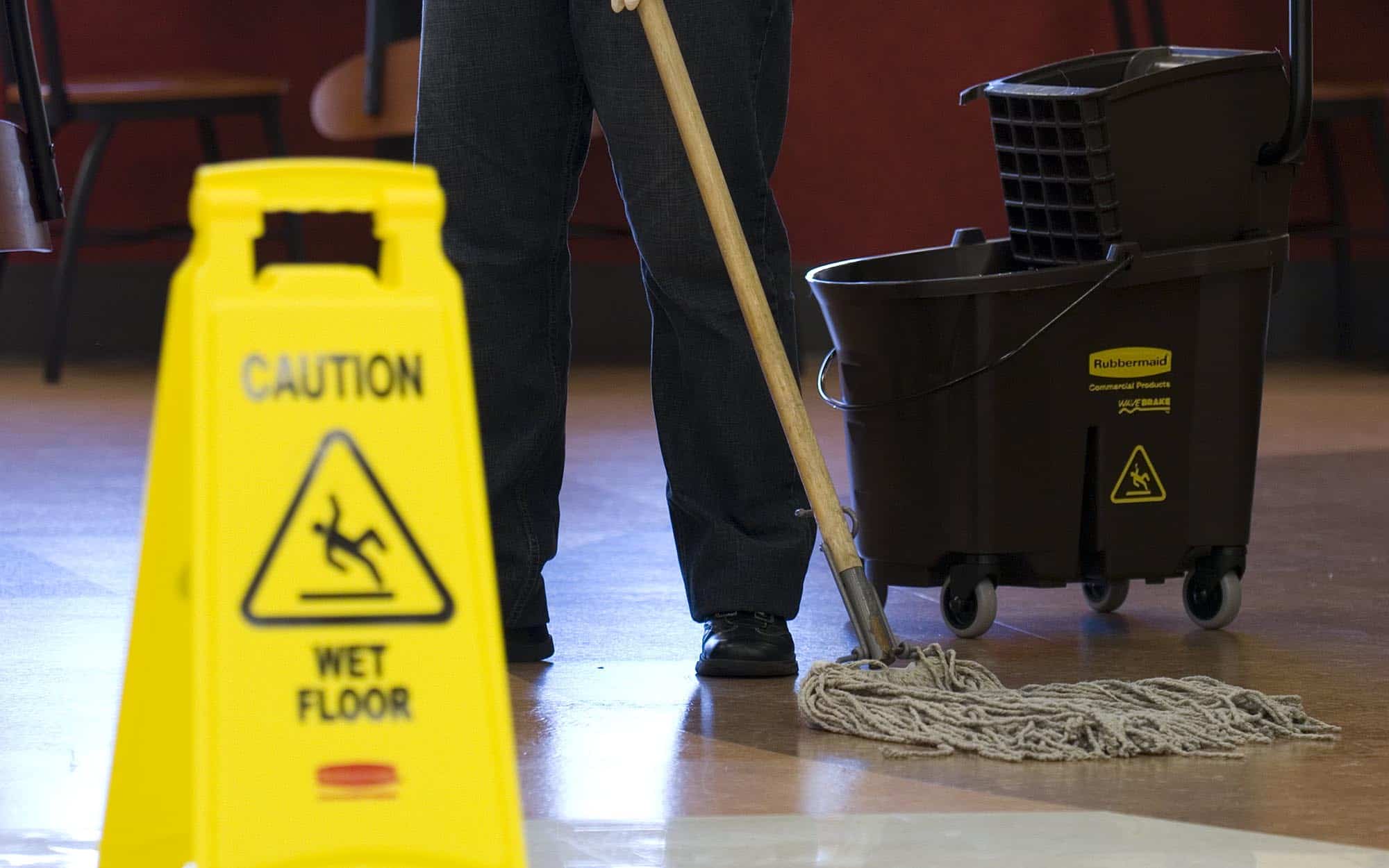
For hard floor surfaces, the rainy season demands two things above all else: more frequent mopping and a closer eye on floor finish condition. Wet floors need to be addressed in real time, which means your cleaning schedule needs to flex with the weather. Posting wet floor signage and keeping absorbent runners in place during peak traffic hours helps manage floor safety in the short term, but it doesn’t replace the need for more frequent damp mopping to remove the abrasive particles that are quietly grinding away at your floor finish with every step.

Floor safety is also directly tied to your finish maintenance schedule. A worn or thin finish loses its grip properties and increases the coefficient of friction risk on smooth surfaces. If your hard floors are due for a buff, recoat, or refinish, the weeks before the rainy season arrives are the right time to schedule that work, not after the damage has been done.

From professional carpet cleaning to hard floor restoration, our commercial floor care programs are built to keep your facility looking its best and your visitors safe, no matter the forecast.

Explore Our Floor Care Services

Floor Safety, Compliance, and Liability

Slip and fall accidents are one of the most common and costly workplace incidents in commercial facilities, and the rainy season is when your exposure peaks. Facilities managers who treat floor safety as a compliance checkbox rather than an active risk management priority are the ones who end up managing incident reports instead of preventing them.

What OSHA Expects From Your Floors

OSHA’s standards u are clear: floors must be kept clean and dry, and where wet processes are used, drainage and dry standing areas must be maintained. In a commercial office context, the “wet processes” are simply the foot traffic your building sees on a rainy Tuesday morning. When water is being tracked in continuously, keeping floors dry is an active, ongoing task, not a one-time response.

The liability exposure from a single slip and fall incident can far exceed what a full season of proactive facility maintenance would have cost. That math is worth running before the first complaint comes in.

Don’t Overlook Humidity and HVAC

Moisture in a commercial building doesn’t just come from what’s tracked in on shoes. High humidity during the rainy season can affect floor adhesive, cause wood or laminate to expand, and create conditions favorable to mold growth beneath carpet or along wall-floor transitions. Keeping your HVAC system functioning properly and maintaining reasonable indoor humidity levels during wet weather is part of a complete floor protection strategy, and it’s one of the most commonly overlooked factors in rainy season facility maintenance.

Adjusting Your Cleaning Program for the Season

One of the clearest differences between facilities that weather the rainy season well and those that don’t is schedule flexibility. Most commercial buildings operate on fixed cleaning schedules that were designed around average conditions, and average conditions don’t exist during a sustained weather event.

A proactive approach means building adjustment triggers into your program ahead of time. That might look like a protocol that increases mopping frequency in entryways when rain is forecast, a mat inspection added to morning opening procedures, or a checklist for day porters that prioritizes wet floor response during peak arrival hours. Small adjustments made consistently produce meaningfully better outcomes than large reactive efforts made after the fact.

It’s also worth investing in simple communication during heavy rain periods. Placing signage near entryways that reminds visitors to wipe their feet, or positioning additional mats visibly near secondary entrances, nudges behavior in a way that reduces the volume of moisture and soil making it onto your floors in the first place.

Stay Ahead of the Rain With Prestige Maintenance USA

At Prestige Maintenance USA, we’ve built our commercial floor care programs around the reality that facility needs change with the seasons. From professional carpet cleaning and hard floor refinishing to day porter support during high-traffic weather events, our teams are equipped to protect your entryways, lobbies, and high-traffic zones before small problems become expensive ones. If your facility’s floor care program needs a rainy season tune-up, contact us today to schedule a consultation and find out what a proactive approach can do for your space.

Share This Post

  • Share on Facebook
  • Share on X
  • Share on WhatsApp
  • Share on Pinterest
  • Share on LinkedIn
  • Share on Tumblr
  • Share on Vk
  • Share on Reddit
  • Share by Mail

More Like This

Professional sweeping commercial floor

The Consequences of Neglecting Commercial Floor Care and Carpet Cleaning

https://prestigeusa.net/wp-content/uploads/2024/11/Professional-sweeping-commercial-floor.jpg 1250 2000 Abstrakt Marketing https://prestigeusa.net/wp-content/uploads/2026/02/Prestige-50th_notag-03-300x164.png Abstrakt Marketing2024-11-22 09:46:082026-05-14 13:56:17The Consequences of Neglecting Commercial Floor Care and Carpet Cleaning
Woman cleaning the floor with polishing machine

Effective Strategies for Daily Hard Surface Floor Care

https://prestigeusa.net/wp-content/uploads/2024/05/Woman-cleaning-the-floor-with-polishing-machine.jpg 1250 2000 Abstrakt Marketing https://prestigeusa.net/wp-content/uploads/2026/02/Prestige-50th_notag-03-300x164.png Abstrakt Marketing2024-05-28 14:39:492026-05-14 13:56:21Effective Strategies for Daily Hard Surface Floor Care
Side view of a floor scrubber

The Importance of Proper Carpet and Floor Care

https://prestigeusa.net/wp-content/uploads/2023/11/Side-view-of-a-floor-scrubber.jpg 1250 2000 Abstrakt Marketing https://prestigeusa.net/wp-content/uploads/2026/02/Prestige-50th_notag-03-300x164.png Abstrakt Marketing2023-11-24 09:00:002026-05-14 13:56:25The Importance of Proper Carpet and Floor Care

Categories

  • Carpet Cleaning
  • Churches
  • Commercial
  • Day Porter
  • Disinfecting
  • Distribution and Fulfillment
  • Education
  • Green Solutions
  • Hard Floor Care
  • Janitorial
  • Manufacturing
  • Retail
  • Safety
  • Warehouse
  • Workplace Experience

Contact Us

"*" indicates required fields

Our Company

About Us

Our Purpose

Awards and Qualifications

Careers

Our Services

Janitorial

Porter Services

Carpet Cleaning

Hard Floor Care

Disinfecting

Green Solutions

Contact Us

1808 10th Street, Suite 300, Plano, TX 75074

800-321-4773

sales@prestigeusa.net

Website by Abstrakt Marketing Group ©
  • Sitemap
  • Privacy Policy
Link to: In-House vs. Outsourced Janitorial Services: What’s Best for Large Commercial Facilities? Link to: In-House vs. Outsourced Janitorial Services: What’s Best for Large Commercial Facilities? In-House vs. Outsourced Janitorial Services: What’s Best for Large Commercial... Link to: Why Spring Is the Best Time for Deep Warehouse Cleaning—and What You Might Be Missing Link to: Why Spring Is the Best Time for Deep Warehouse Cleaning—and What You Might Be Missing Top-Down View In Warehouse People WorkingWhy Spring Is the Best Time for Deep Warehouse Cleaning—and What You Might...
Scroll to top Scroll to top Scroll to top

This site uses cookies. By continuing to browse the site, you are agreeing to our use of cookies.

AcceptLearn more

Cookie and Privacy Settings


How we use cookies

We may request cookies to be set on your device. We use cookies to let us know when you visit our websites, how you interact with us, to enrich your user experience, and to customize your relationship with our website.

Click on the different category headings to find out more. You can also change some of your preferences. Note that blocking some types of cookies may impact your experience on our websites and the services we are able to offer.

Essential Website Cookies

These cookies are strictly necessary to provide you with services available through our website and to use some of its features.

Because these cookies are strictly necessary to deliver the website, refusing them will have impact how our site functions. You always can block or delete cookies by changing your browser settings and force blocking all cookies on this website. But this will always prompt you to accept/refuse cookies when revisiting our site.

We fully respect if you want to refuse cookies but to avoid asking you again and again kindly allow us to store a cookie for that. You are free to opt out any time or opt in for other cookies to get a better experience. If you refuse cookies we will remove all set cookies in our domain.

We provide you with a list of stored cookies on your computer in our domain so you can check what we stored. Due to security reasons we are not able to show or modify cookies from other domains. You can check these in your browser security settings.

Other external services

We also use different external services like Google Webfonts, Google Maps, and external Video providers. Since these providers may collect personal data like your IP address we allow you to block them here. Please be aware that this might heavily reduce the functionality and appearance of our site. Changes will take effect once you reload the page.

Google Webfont Settings:

Google Map Settings:

Google reCaptcha Settings:

Vimeo and Youtube video embeds:

Accept settingsHide notification only